Database sharding splits one database into many smaller pieces. Each piece holds a slice of the data, so no single machine has to store all of it or answer every query alone. Teams reach for it when one database can no longer keep up with the traffic, the storage, or both. On paper, that sounds like a scaling decision a team makes once and then moves past.
In practice, database sharding is a migration, and migrations have a track record worth knowing before anyone commits to one. That record isn’t encouraging. Database migrations run long, run over budget, and cause more downtime than most teams plan for.
Database sharding sits near the hardest end of that range. It touches live data, live queries, and live traffic all at the same time. The decision to shard is usually made for good reasons. The execution is where things actually go wrong, and that gap between intent and execution is what this piece is really about.
This piece walks through how often database migrations miss their deadline, and what a production database sharding setup at serious scale looks like day to day. It also covers why the performance problem a team is trying to solve is often not a capacity problem at all. And it covers how fast the database landscape underneath that decision keeps shifting, along with what actually has to be staffed before a shard key gets chosen.
Most database migrations miss their deadline, and sharding is one of the hardest kinds
Caylent surveyed 308 US-based IT leaders in July 2025, each with direct experience managing at least one major database migration in the prior two years. The survey covered database migrations broadly: cloud-to-cloud moves, platform switches, version upgrades, and the kind of horizontal scaling work that database sharding falls under. It didn’t isolate sharding specifically. Sharding is widely considered one of the hardest and most disruptive migration types an organization can take on. That makes the survey’s findings a fair description of the conditions a sharding project walks into before a single shard key gets chosen.
Caylent found only 6% finished their hardest migration on time
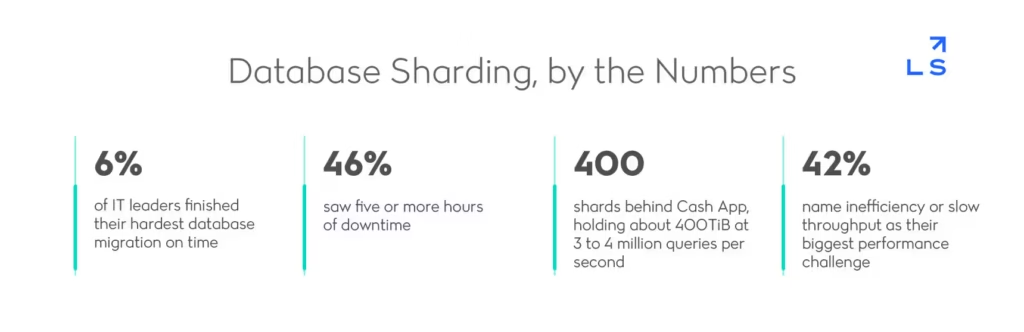
Respondents were asked how their most challenging database migration compared to its original plan. Caylent’s Database Modernization Bottleneck survey found only 6% completed on time, which means 94% ran past their original deadline. Nearly 85% said the slip stretched somewhere between one week and six months, and 4% reported delays of more than six months.

The cost wasn’t limited to one sector either. Every industry in the survey reported a negative revenue impact from downtime. That makes this a general pattern in database migration work, not a problem specific to unusually complex systems.
Nearly half saw five or more hours of downtime along the way
Downtime wasn’t rare either. The same survey found 46% of respondents experienced five or more hours of downtime during their most challenging migration, and only 6% achieved zero downtime at all. That downtime turned into real business impact: 51% reported customer experience issues, 49% reported lost revenue, and 44% reported operational slowdowns.
None of this is specific to database sharding. It is simply what hard database migration work looks like in general. Database sharding is the kind of project most teams would put in the “most challenging” category Caylent asked about. A team planning to shard should expect to inherit this same baseline risk before anything about shard keys or data models even enters the conversation.
Caylent also asked what was actually driving these migrations in the first place. Removing vendor lock-in topped the list at 34%, ahead of reducing database licensing spend at 28% and improving scalability at 13%. That ordering is worth sitting with. Most organizations aren’t migrating, or sharding, because they set out to build a more scalable platform from a position of strength. They’re migrating because a contract or a cost line forced the question, and scalability work, sharding included, often rides along on a decision that was really about something else.
Cash App’s 400-shard database shows what long-term sharding looks like
Database sharding doesn’t end once the migration finishes. The ongoing operational reality of running a heavily sharded database is its own separate story. Cash App’s engineering team has published enough detail about its own setup to show what that reality actually involves.
Their system runs on Vitess, an open-source project built specifically to manage large fleets of sharded MySQL databases. It’s paired first with PlanetScale’s managed platform, and later with PlanetScale Metal, a bare-metal variant of that same service.
What Cash App describes is less a single sharding event with a clear finish line and more a continuously managed system that keeps changing shape as the business grows. Behind that system sits hundreds of otherwise ordinary MySQL instances, each one running inside its own Kubernetes pod alongside a piece of Vitess middleware called VTTablet. Database sharding at this scale is less one big database and more a fleet of small, ordinary ones, coordinated carefully enough to behave like a single system from the outside.
Vitess and PlanetScale scaled Cash App to 400TiB and 3 to 4 million queries per second
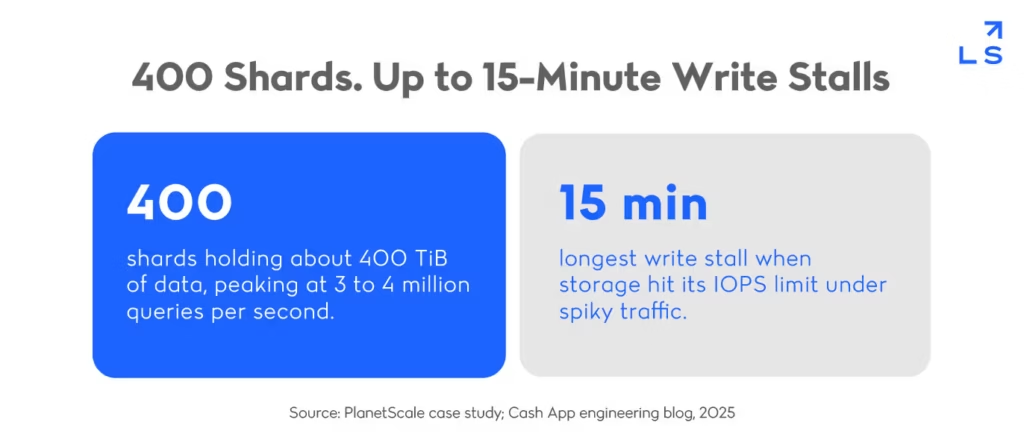
PlanetScale’s case study on Cash App puts the scale in concrete terms: roughly 400 shards, about 400TiB of data, and peak traffic of 3 to 4 million queries per second. Cash App had already outgrown two large MySQL clusters before adopting Vitess. Growth after that point meant splitting shards repeatedly, rather than running one big sharding migration and calling the project finished.
Database sharding at that scale isn’t a project with a fixed end date. It functions more like a standing capability a team has to maintain indefinitely, with new splits arriving as a predictable part of normal growth rather than as a one-time event.
Even at 400 shards, the storage underneath could stall writes for up to 15 minutes
Cash App’s own engineering blog, writing about its move to PlanetScale Metal in March 2025, described a specific operational problem on its prior cloud setup. Network-attached storage volumes would periodically hit their IOPS limits under spiky traffic. When that happened, the affected shards could stop accepting writes for up to 15 minutes at a time.
That wasn’t a migration failure. It was ordinary operation on infrastructure that had been running in production since the earlier migration. It is also one of the concrete reasons Cash App moved to Metal, which pairs compute and storage on the same NVMe hardware instead of over a network.
After the move, the team reported p99 latency on its main workload dropping by 50%. That’s a meaningful result, but it’s worth noting it took a second infrastructure change on top of the original database sharding work to actually achieve.
A common performance problem isn’t capacity
Teams often reach for database sharding the moment a database feels slow, treating the slowness as proof that one machine has run out of room. Percona’s own 2026 survey of database professionals suggests that read is wrong more often than it should be. One of its clearest findings wasn’t about running out of capacity at all. It was about efficiency, which is a different problem with a different fix, and one database sharding doesn’t actually solve on its own.
42% name inefficiency or slow throughput as their biggest performance challenge
Percona’s State of Open Source Database Management report surveyed 300 US-based DBAs, SREs, and platform engineers. It found 42% name inefficiency or slow throughput as their biggest performance challenge.

That’s a statement about how a database is being used, not about how much hardware sits underneath it. A query doing more work than it needs to will stay slow no matter how many machines are behind it. Database sharding changes the hardware. It does nothing to change the query.
Sharding doesn’t fix a bad query plan, it just adds machines to argue with each other
Splitting an inefficient query across ten shards instead of running it on one doesn’t make that query efficient. It means ten machines now each run the same unnecessary work instead of one, and the application still has to stitch the results back together afterward.
Database sharding is a real fix for a database that has genuinely outgrown a single machine’s write throughput or storage ceiling. It is not a fix for a slow query, a missing index, or a data model that was never designed for the access pattern an application actually uses. Teams that shard before ruling those simpler causes out tend to inherit all of database sharding’s operational cost anyway. They still haven’t solved the problem that sent them looking for a fix in the first place.
The same Percona survey found a related cost signal worth factoring in before that decision gets made. 31% of respondents name rising cloud spend as their top barrier to cost optimization. A sharding setup that multiplies compute and storage across many machines tends to multiply that cloud bill right alongside it.
A team solving the wrong problem with database sharding doesn’t just fail to fix the slow query. It also pays more every month for the privilege of not fixing it. That’s a cost most teams don’t price in until the first invoice arrives after the migration closes.
The database landscape is shifting under the decision, not holding still
A database sharding decision doesn’t get made against a fixed backdrop. The relative popularity of database engines, and the practical cost of being locked into one, both keep moving while a team is still deciding how to scale. Two separate pieces of 2026 research describe that movement from different angles. One tracks which databases are actually gaining ground with practitioners, and the other tracks how painful it becomes to leave a given platform once a team has committed to it. Neither angle holds still long enough for a one-time decision to age well.
PostgreSQL recorded the largest popularity gain of H1 2026
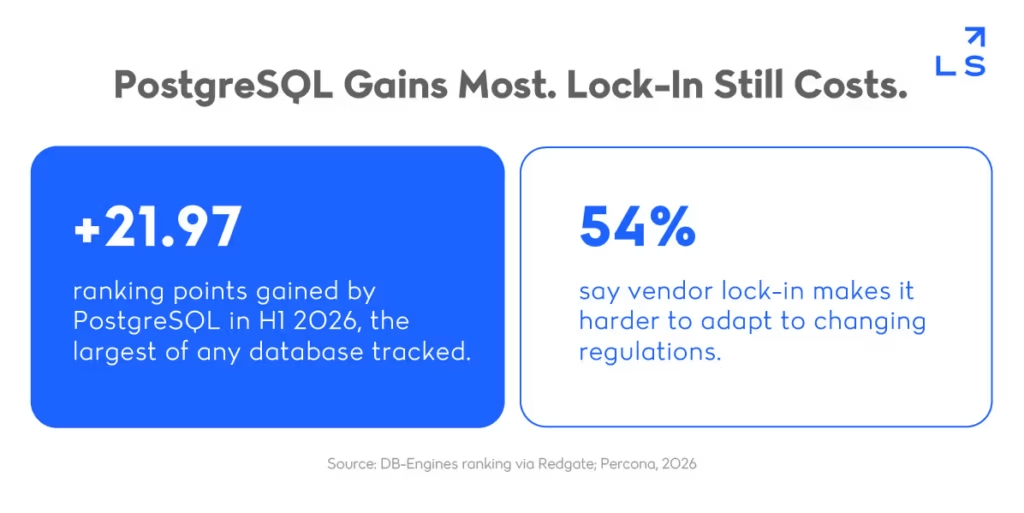
DB-Engines’ ranking, covered by Redgate, tracks database popularity using search interest, job postings, and technical discussion volume across more than 400 technologies. Across the first half of 2026, PostgreSQL gained more ranking points than any other database tracked, up 21.97 points. Databricks followed at +16.04, and MongoDB at +11.24, with Microsoft Fabric and Snowflake rounding out the top five gainers.
For a team deciding what to shard, or what engine to shard onto, that’s a live signal about where tooling, hiring pools, and community support are actually headed. It isn’t a static fact that got decided once years ago and never needs revisiting. Landskill’s own look at vector database decisions runs into the same pattern from a different angle: engine popularity and maturity keep changing well after a team’s original choice gets made.
Vendor lock-in makes it harder to adapt when regulations change
Percona’s same 2026 survey found 54% of respondents say vendor lock-in makes it harder to adapt to changing regulations. That constraint typically only becomes visible well after a platform decision has already been made. A database sharding approach built entirely around one vendor’s proprietary tooling carries that same risk forward into every future decision about where that data can live.
The database doing the sharding is one decision. The platform that sharding runs on top of is another. Both are decisions a team has to expect to live with for far longer than the migration itself actually takes.
A shard key choice outlives the team that picked it
Every sharded database is organized around a shard key: the field used to decide which shard a given row belongs to. Get it right and most queries stay on a single shard. Get it wrong and the system spends years running cross-shard queries that are slower and harder to reason about than anything a single, unsharded database ever had to deal with.
That choice is also one of the hardest things to undo once real data and real production traffic depend on it. That’s exactly why database sharding decisions deserve more scrutiny up front than they typically get.
Resharding means moving live data between machines without losing a write
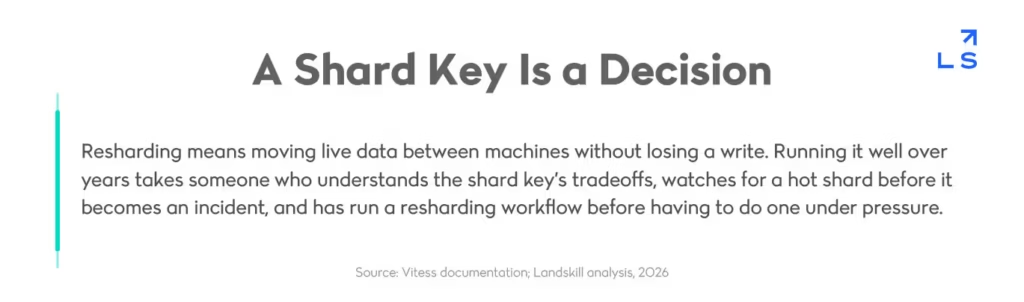
Changing a shard key, or simply adding more shards as data grows, means resharding. That means moving live data between machines while the application keeps reading and writing against it the entire time. Nothing about that process is simple. Rows have to move, indexes have to rebuild, and the cutover has to happen without silently dropping or duplicating a single write anywhere in the process.
Vitess, the project behind Cash App’s setup, treats resharding as a formal, tooled workflow rather than a one-off script. That’s deliberate. The cost of getting it wrong in production is real and immediate.
A resharding workflow typically keeps the old and new shards running side by side for a period, copying data across while traffic still hits the original shards. Only once the copy is verified does traffic actually cut over, and a reversible path back to the old shards stays available in case something looks wrong after the switch. That reversibility is exactly what separates a formal resharding workflow from a manual one. Without that safety net, backing out of a bad cutover under live production load is a much harder thing to do safely. It’s also a much easier thing to get wrong at 2am, with a page already going off and a decision that can’t wait.
Why this is a staffing question, not just a technical one
Running database sharding well over years takes more than executing one migration and moving on. It needs someone who understands the shard key’s tradeoffs and watches for a hot shard before it becomes an incident. It also needs someone who owns the resharding playbook well before it’s needed under pressure.
Landskill’s own Platform Engineering piece covers a closely related gap: teams that adopted new infrastructure practices quickly but never built the measurement discipline to actually run them well. Landskill’s OpenTelemetry piece describes the other half of that same problem specifically for a sharded system. A team that cannot see which shard is running hot has no real way to know resharding is needed until something has already broken in production.
The same staffing gap shows up in how a team chooses between streaming and batch processing for the data flowing into a sharded system in the first place. Landskill’s Streaming vs Batch Processing piece covers that upstream decision, which shapes how predictable the load on any given shard actually is.
Treat sharding as a staffed decision, not a one-time migration
Database sharding earns its hard reputation honestly. Caylent’s numbers show database migrations in general running long and causing real downtime far more often than teams expect going in. Cash App’s own numbers show something else entirely. Even a mature, well-tooled database sharding setup still has operational edges that show up years after the original migration finished, like storage hitting its limits under spiky traffic.
Percona’s numbers add the last piece. A lot of the pain teams blame on capacity is actually about inefficiency, and that problem shows up whether or not a team ever ships a single shard. Fixing it first is usually cheaper and faster. It’s also a lot less risky than committing to a multi-year infrastructure change. A better query plan, applied early, often solves the same problem for a fraction of the engineering time.
None of that is an argument against database sharding when a database genuinely needs it. It’s an argument for treating database sharding as a standing capability rather than a weekend project. That means someone who owns the shard key decision and someone who watches for the next hot shard before it pages anyone at 2am. It also means someone who has actually run a resharding workflow once before doing it for the first time under production load.
IT Outsourcing and Nearshore both exist to add that kind of specialized capacity for a team that doesn’t have it in-house yet, without turning it into a permanent hiring search. Get in touch to talk through what your own database sharding roadmap actually needs before the next migration starts.