
Two years ago, WebAssembly was mostly a browser story: a fast, portable compile target that made Figma and Photoshop feel native on the web. That story hasn’t gone away, and browser usage has kept climbing rather than plateauing. But it’s no longer the whole picture. Between the WebAssembly 3.0 specification landing, WASI’s component model reaching native async, and a wave of acquisitions and JVM tooling aimed squarely at servers, WebAssembly spent 2025 and early 2026 quietly becoming something backend and platform teams can’t dismiss as a browser curiosity anymore.
None of this means WebAssembly is ready to replace your Kubernetes cluster. It isn’t, and pretending otherwise does a disservice to teams trying to plan real infrastructure. What follows are six concrete, sourced shifts, what actually changed, who’s shipping on WebAssembly in production, and where the gaps still are, so you can decide where WebAssembly is worth your team’s time this year and where it still isn’t.
What WebAssembly 3.0 Actually Shipped
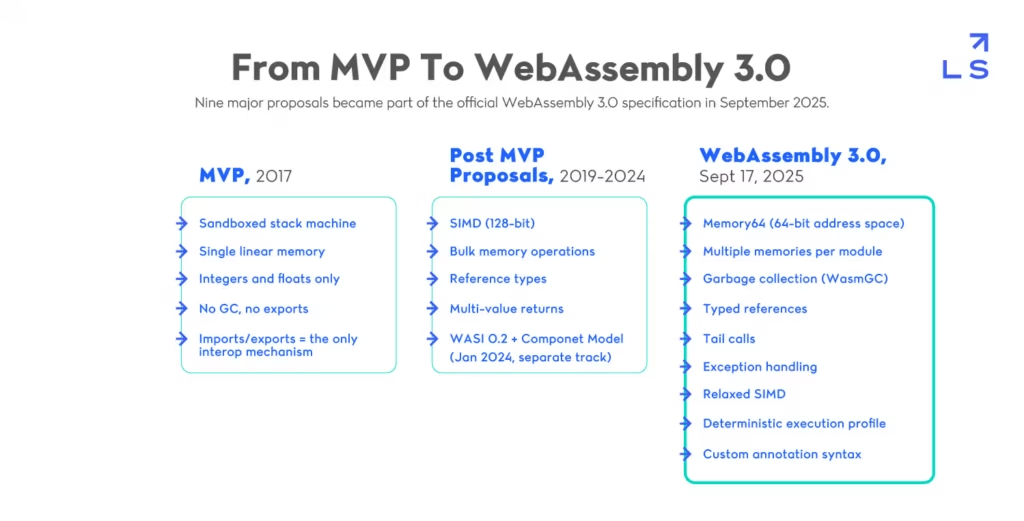
WebAssembly 3.0 became a W3C standard in September 2025, and it’s the biggest jump the spec has taken since the original MVP. Andreas Rossberg’s announcement on behalf of the WebAssembly Community Group lists the headline features: a 64-bit address space through memory64, support for multiple memories in a single module, garbage collection, typed references, tail calls, exception handling, relaxed SIMD, a deterministic execution profile, and a custom annotation syntax. Nine of those features moved from proposal to standardized spec in this single release, which is an unusually large batch for a project that has historically shipped incrementally.
Memory, Garbage Collection, and Exception Handling Reach the Spec
The two changes that matter most for language authors are garbage collection and exception handling. Before WasmGC, a compiler targeting WebAssembly had to bundle its own garbage collector inside the binary, the approach Go used for years, which produces bloated modules and duplicated memory management logic. WasmGC lets the module declare typed heap objects and hand collection off to the host runtime instead. Native exception handling closes a similar gap: languages that rely on structured exceptions no longer need to encode control flow through return codes or trampolining tricks to simulate a throw.
Why Toolchains Care More Than End Users Do
If you’re shipping a product today, WebAssembly 3.0 is mostly invisible to you, which is exactly the point. The features land in compiler backends and runtimes first, then surface as smaller binaries and fewer workarounds for the people building on top of them. Wasmtime support was “on track to completion” at the time of the announcement, and the spec is already shipping in most major browsers. Tail calls and relaxed SIMD matter for a narrower audience, mostly functional-language compilers and numeric workloads, but they close two of the longer-standing gaps between what WebAssembly could express and what native code could.
The practical effect shows up a layer down: new languages can target WebAssembly through GC without writing a custom memory manager, which is precisely what unlocked the current wave of JVM-language tooling covered further down. Rossberg’s announcement specifically calls out Java, OCaml, Scala, Kotlin, Scheme, and Dart as languages now positioned to target WebAssembly through garbage collection rather than bundling their own runtime. If you’ve spent time evaluating JavaScript bundlers and transpilers, the pattern here will feel familiar: a WebAssembly toolchain absorbs the same kind of syntax and memory-management complexity so the rest of the stack doesn’t have to.
The Component Model Turns Modules Into Interoperable Building Blocks
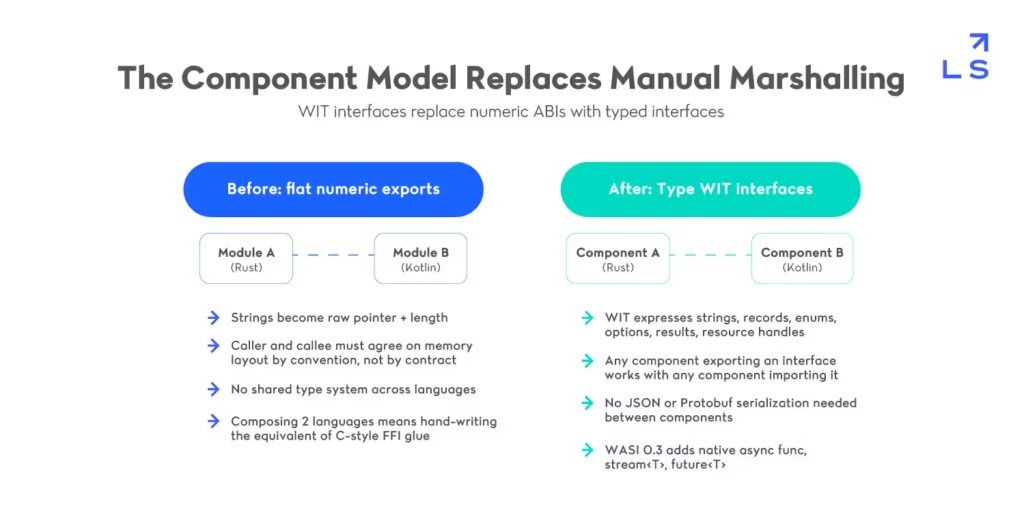
Before the component model, a WebAssembly module was a flat set of imports and exports typed only as integers and floats. Composing two modules written in different languages meant manually marshalling strings into memory offsets and passing raw pointers around, interop that belonged in 1990s C, not a modern toolchain. The Bytecode Alliance’s Component Model fixes that by giving modules a real interface type system.
WIT Interfaces Replace Manual Pointer Marshalling
WIT (WebAssembly Interface Types) is the IDL that makes this work. It expresses strings, records, enumerations, options, results, and resource handles, rich enough to describe a real API contract rather than just a function signature. A component that exports a wasi:http/incoming-handler interface can be composed with any other component that imports it, regardless of which language produced either side.
wasmCloud describes components as behaving like proper LEGO bricks for exactly this reason: a Rust component can link to a Kotlin component can link to a C component through a typed contract instead of an ABI hack, with no intermediate JSON or protobuf serialization layer needed at the boundary. That’s a genuine architectural upgrade, not a feature bump, because it means language neutrality stops being aspirational and becomes something you can actually build against.
WASI 0.3’s Native Async Closes the Last Ergonomic Gap
The Bytecode Alliance ratified WASI 0.3 on June 11, 2026, rebasing WASI onto the component model’s native async primitives: async func, stream<T>, and future<T>. Previously, wasi:io handled pollables and streams as a bolt-on; WASI 0.3 moves that machinery into the canonical ABI itself, which removes the callback-based workarounds that made network I/O feel awkward under WASI 0.2. Runtime and toolchain support is landing now in Wasmtime 43 and JCO. The timing lines up with what the wasmCloud maintainers were already describing weeks earlier: JCO 1.20 passing all 46 upstream Wasmtime WASI test cases as a second compliant reference implementation, which is the kind of independent verification a spec needs before a subgroup will vote to ratify it.
Production WebAssembly Lives at the Edge, Not the Backend Yet
Ask where WebAssembly is actually handling production traffic today, and the honest answer is narrower than the hype suggests: short-lived, stateless, I/O-light handlers that benefit from near-instant cold starts. That’s a real, valuable niche, but it’s not general-purpose backend computing yet, and treating it as such is where adoption plans go wrong.
Fastly, Cloudflare, and Fermyon Show Where Cold Starts Matter Most
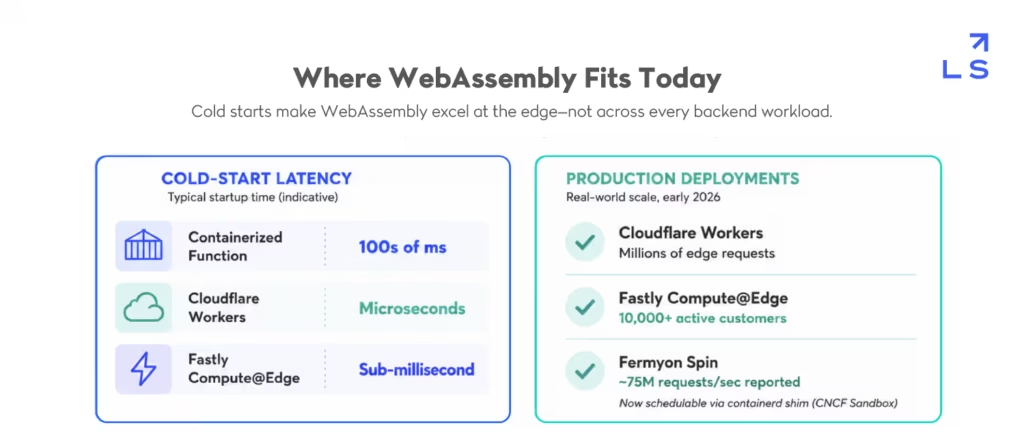
Fastly’s Compute@Edge platform serves over 10,000 active users, and Cloudflare Workers handles millions of requests with cold-start times measured in microseconds rather than the hundreds of milliseconds typical of a containerized function. Fermyon Spin’s edge platform reportedly processes on the order of 75 million requests per second, and Spin joined the CNCF Sandbox, meaning Wasm workloads are now schedulable directly through Kubernetes via a containerd shim, the same orchestration layer most platform teams already run.
These are the deployments actually proving out WebAssembly’s cold-start advantage at scale, and they share a profile: short-lived, stateless, I/O-light handlers where instantiation speed is the bottleneck that matters, and none of them is a general-purpose transactional backend. If your workload doesn’t fit that profile, the cold-start advantage that makes WebAssembly compelling at the edge won’t translate to a meaningful win further back in your stack, the same way a team doing careful JavaScript performance optimization on a slow admin dashboard would look at real user data before reaching for a rewrite.
Akamai’s Acquisition of Fermyon Signals Where the Market Is Betting
On December 1, 2025, Akamai announced it was acquiring Fermyon to expand its own edge capabilities. The two companies had already been working together for more than a year, with Fermyon’s technology integrated into Akamai’s infrastructure and sold through a partner arrangement; the acquisition formalizes that relationship and brings co-founders Matt Butcher and Radu Matei into Akamai’s Cloud Technology Group, where they’re expected to continue leading Fermyon’s open-source project.
An infrastructure vendor the size of Akamai buying a WebAssembly FaaS company outright, rather than continuing to partner, is a stronger signal about where edge compute investment is heading than any adoption survey could offer. It also means Spin’s open-source roadmap now sits inside a company with the distribution to put WebAssembly workloads in front of a much larger base of edge customers than a standalone startup ever could, which is worth watching if your own edge strategy currently runs through Akamai.
JVM Languages Finally Have a Path to WebAssembly
For years, the honest answer to “can I compile Java to WebAssembly” was “sort of, with caveats.” That’s changed meaningfully in the last twelve months, though the caveats haven’t disappeared so much as moved. The shift now runs in both directions: JVM languages can target WebAssembly directly, and WebAssembly runtimes are starting to embed inside the JVM itself, each path with its own maturity level and tradeoffs.
TeaVM and Kotlin/Wasm Target WasmGC Directly
TeaVM compiles JVM bytecode, not source, to WasmGC, which means it handles Kotlin and Scala for free since both compile to the same bytecode. It’s considered production-ready for browser targets as of late 2025. For server-side WASI targets specifically, Fermyon maintains a community fork called teavm-wasi that adds WASI support and component model bindings, though that fork remains experimental rather than merged upstream.
Kotlin/Wasm, JetBrains’ own toolchain, reached Beta in September 2025; Compose for Web runs on it and JetBrains’ internal benchmarks show it performing roughly three times faster than the equivalent Kotlin/JS build in UI-heavy workloads. The wasm-wasi target lets Kotlin run outside the browser too, but as of the most recent roadmap it’s still Beta overall and not yet recommended for production server workloads.
Endive and GraalVM Web Image Attack the Problem From the Host Side
The newest entrant approaches this from the opposite direction. Endive, announced by the Bytecode Alliance as a fork of the Chicory pure-Java Wasm interpreter with a Cranelift compiler backend added for performance, lets a JVM process embed WebAssembly instead of compiling to it. It ships as a zero-native-dependency install, which matters for teams that can’t add native library dependencies to an existing JVM deployment pipeline. At a recent wasmCloud community call, a maintainer demonstrated Endive Host, a proof-of-concept wasmCloud host written entirely in Java that registered itself over NATS, pulled modules from an OCI registry, and was scheduled by the standard runtime operator with no awareness it was a JVM rather than the usual Rust host.
A second demo embedded Wasm handlers alongside plain Java handlers in a single Eclipse Vert.x event loop, calling a Rust-compiled markdown-to-HTML module from Java code and merging the result with a server-side timestamp, with the caller unaware it was talking to WebAssembly at all. Endive doesn’t yet support the component model, which the maintainers named as the single biggest blocker to unlocking its language bindings; getting the basic scheduling protocol working reportedly took a fraction of the effort of faking a WASI HTTP handler around that gap.
For the reverse direction, compiling existing Java to WebAssembly, GraalVM Web Image’s native-image AOT compiler was pointed to as the complementary path worth watching, alongside Google’s earlier and still-experimental J2Wasm project, neither of which has a firm production timeline yet. wasmCloud’s own host already wires into Kubernetes and OpenTelemetry for traces and spans, so a Java-embedded Wasm host built on Endive inherits that observability path rather than needing a separate one bolted on.

Sandboxing Makes WebAssembly a Natural Fit for Untrusted Code
WebAssembly’s isolation model was designed for browsers running code from strangers on the internet, and that same design is turning out to matter for a very different kind of untrusted code: output from AI agents and coding assistants that a system has to execute without knowing in advance what it will do.
Capability-Based Security Beats Default-Open Runtimes
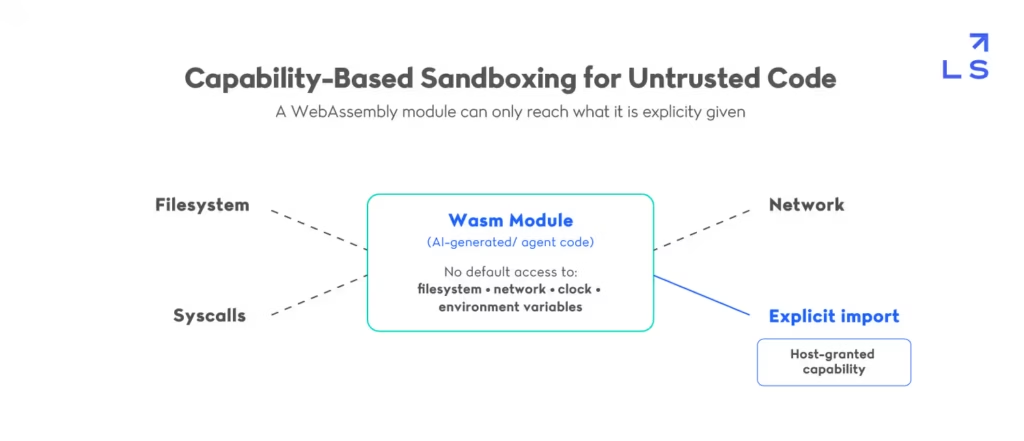
A WebAssembly module has no filesystem access, no network socket, and no clock unless the host explicitly grants that capability through an import; there’s no ambient authority to abuse. The callstack itself is inaccessible to the running module, and every control transfer, direct or indirect, resolves to a type-checked destination, which rules out the kind of stack-smashing and jump-to-arbitrary-address attacks that plague native sandboxes.
Runtimes add defense-in-depth on top of that baseline, guard regions around linear memory, zeroing memory between instances, and Spectre mitigations on indirect calls, precisely because a spec-level guarantee is only as good as the implementation enforcing it. That’s a meaningfully different security posture than container security, which typically layers process isolation and zero-trust network policy on a shared kernel rather than isolating the code’s own capabilities, and it’s why a compromised WebAssembly module has a much narrower blast radius than a compromised container process by default.
AI-Generated and Agent-Executed Code Raises the Stakes
The New Stack argued in March 2026 that this capability model gives WebAssembly a real edge over containers and microVMs specifically for executing AI agent-generated code, where the whole premise is that you can’t fully vet what you’re about to run before you run it. The same logic already applies to any plugin architecture that runs code you didn’t write and can’t fully review in advance, which is why deny-by-default sandboxing became the default assumption for CDN edge functions and plugin systems well before agents entered the picture. As more of what runs in production is generated rather than hand-written, that default matters more, not less.
Where WebAssembly Still Falls Short in 2026
None of the above is a reason to rip out your existing stack, and the teams shipping WebAssembly successfully in production are explicit about where it doesn’t belong yet.
Threading and General Microservices Are Not There Yet
Threading support in WASI remains unresolved, and without it, database connection pools, parallel request handling, and high-throughput I/O stay out of WebAssembly’s reach for now. Nobody is running a general-purpose microservices backend on WebAssembly in production at meaningful scale in 2026; the deployments that work are edge and CDN platforms, serverless functions, and internal plugin systems, not transactional business logic.
Migrating a Spring or Quarkus workload to WebAssembly today means betting on a threading proposal with no confirmed ship date, and the JVM toolchains that would carry that migration, Kotlin/Wasm’s server target and Endive’s component-model support alike, are still Beta or pre-component-model themselves. That combination of gaps compounds rather than cancels out: even a team comfortable with an early-stage runtime is still blocked on a language toolchain that isn’t ready, and vice versa.
A Realistic Adoption Checklist for Platform Teams
The practical posture for most teams: learn WIT and the component model now, since the interface type system is stable and won’t change substantially before 1.0, and that knowledge transfers regardless of which language you write components in. If you’re a Kotlin Multiplatform shop, evaluate Kotlin/Wasm for browser targets, where Compose for Web is genuinely usable today. If sub-millisecond cold starts matter for a specific workload, prototype it on Fermyon Spin or a similar edge runtime rather than waiting. And if your roadmap involves migrating existing backend services, wait for WASI’s threading story and for the JVM toolchains covered above to graduate out of Beta before committing production workloads to it.
Whichever of these applies to you, treat it the same way you’d evaluate any infrastructure bet: pilot the narrow case that’s genuinely ready, wire it into the CI/CD pipeline automation you already run for everything else, and let the pilot produce real evidence before it goes anywhere near a roadmap slide. If you’re weighing where WebAssembly fits in your architecture, or want to have a chat on how to improve overall technical performance, schedule a call with Landskill and we’ll get to work.