
As frontend systems scale, performance rarely fails catastrophically—it degrades incrementally. A slightly heavier bundle, an extra dependency, a delayed API response. Each change is small, often justified in isolation, but together they introduce friction that compounds over time.
In growing teams, this problem accelerates. More developers contribute to the same codebase, release cycles shorten, and architectural decisions become distributed. Without a shared constraint system, performance becomes subjective, inconsistent, and ultimately invisible until users start to feel it.
This is where Frontend Performance Budgets become essential. Instead of treating performance as a reactive metric, Frontend Performance Budgets define explicit limits that guide development decisions before performance issues emerge. They transform performance from an outcome into a design constraint embedded directly into the system.
According to Google’s Web Fundamentals, these performance budgets are one of the most effective mechanisms for maintaining consistent user experience as applications evolve, particularly in environments with frequent releases and multiple contributors.
This article explores how performance budgets work at a system level, how to implement Frontend Performance Budgets across teams and pipelines, and how these budgets enable organizations to scale frontend development without sacrificing speed or user experience.
What Frontend Performance Budgets Actually Define
Frontend Performance Budgets as System Constraints
Frontend performance budgets are not performance targets—they are constraints that define how a frontend system is allowed to evolve. Instead of measuring performance after implementation, Frontend Performance Budgets introduce boundaries that every change must respect before it reaches production.
This shifts performance from an outcome to a design input. When performance budgets are in place, adding a dependency, increasing bundle size, or modifying rendering behavior becomes a measurable tradeoff against a predefined limit. Decisions are no longer based on assumptions of impact—they are evaluated against a constrained system.
As a result:
- performance becomes a design-time concern
- architectural decisions are influenced earlier
- regressions are prevented instead of detected
A non-obvious implication is that most performance issues are not caused by poor implementation, but by systems that grow without constraints. Frontend Performance Budgets introduce those constraints explicitly, making performance enforceable instead of aspirational.
This aligns with how performance is evaluated through user-centric metrics such as Core Web Vitals, where performance is defined through measurable thresholds rather than subjective perception.
The Different Layers Frontend Performance Budgets Control
Performance budgets operate across multiple layers of the system. Treating them as a single metric—such as bundle size—is one of the main reasons they fail in practice.
In reality, Frontend Performance Budgets define constraints across:
- Network layer — total transferred size (JavaScript, CSS, images)
- Rendering layer — metrics such as Largest Contentful Paint (LCP) and layout stability
- Execution layer — main thread blocking time and JavaScript execution cost
- Dependency layer — third-party scripts and external services
Each layer introduces a different failure mode. Reducing bundle size, for example, does not guarantee better performance if execution time remains high due to heavy runtime processing.
A critical insight here is that execution cost is often the dominant bottleneck in modern frontend systems, yet it is the least constrained. Frontend Performance Budgets that ignore execution create an incomplete model of performance.
JavaScript execution, in particular, has a direct impact on main thread blocking and responsiveness, making it one of the most important factors to control when defining performance budgets.
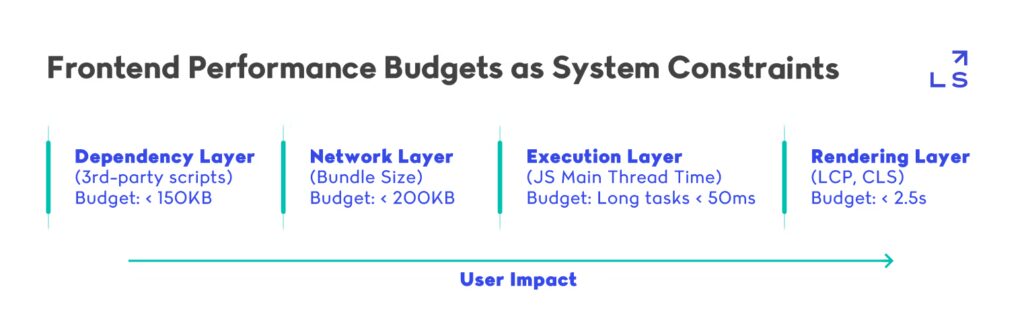
This layered view makes it clear that these budgets are not a single metric, but a system of constraints that must be enforced across different parts of the frontend architecture.
Why Performance Fails Without Frontend Performance Budgets
Without Frontend Performance Budgets, frontend systems evolve without boundaries. The pattern is predictable and consistent across teams:
- initial performance is strong
- features are added incrementally
- dependencies accumulate
- performance degrades gradually
- optimization becomes reactive
The core issue is not degradation itself, but the absence of enforcement during development. Without performance budgets, there is no mechanism to prevent performance regressions at the moment they are introduced.
As teams scale, this becomes more severe:
- ownership becomes fragmented
- different teams introduce conflicting standards
- performance regressions are detected too late
A non-obvious consequence is that monitoring alone does not solve the problem. Observability can surface issues, but without these budgets, it only describes a system that is already out of control.
These mirrors challenges seen in delivery pipelines, where lack of constraints leads to instability despite high levels of automation.
How Frontend Performance Budgets Work in Practice
Defining Frontend Performance Budgets at the System Level
Performance budgets are only effective when they are defined before implementation begins. If they are introduced after the system is already evolving, they become reactive thresholds instead of architectural constraints.
At a system level, Frontend Performance Budgets define acceptable limits such as:
- maximum JavaScript payload per route
- target rendering thresholds
- limits on third-party script weight
- constraints on main thread blocking time
These limits are derived from real-world conditions—network variability, device capabilities, and user expectations. A system designed for mobile users on constrained networks requires significantly stricter Frontend Performance Budgets than one operating in controlled environments.
A critical implication is that performance budgets shape architecture early. Decisions such as server-side rendering, static generation, or code-splitting are often dictated by the need to remain within defined constraints.
This approach aligns with how web performance is standardized, where performance is treated as a measurable system with defined metrics and constraints rather than a subjective quality.
Enforcing Frontend Performance Budgets in CI/CD Pipelines
Defining budgets is only the first step. Without enforcement, they quickly become documentation rather than constraints.
In practice, performance budgets are integrated into CI/CD pipelines, where they act as automated control points. Every change is evaluated against predefined thresholds before it is allowed to progress.
Typical enforcement patterns include:
- failing builds when bundle size exceeds limits
- blocking pull requests when performance regressions are detected
- comparing performance metrics across commits
This transforms Frontend Performance Budgets into a continuous validation mechanism. Performance is no longer checked periodically—it is enforced continuously as part of the delivery system.
This model is reflected in tools like Lighthouse CI, where performance thresholds are automatically validated during the delivery process rather than audited after release.
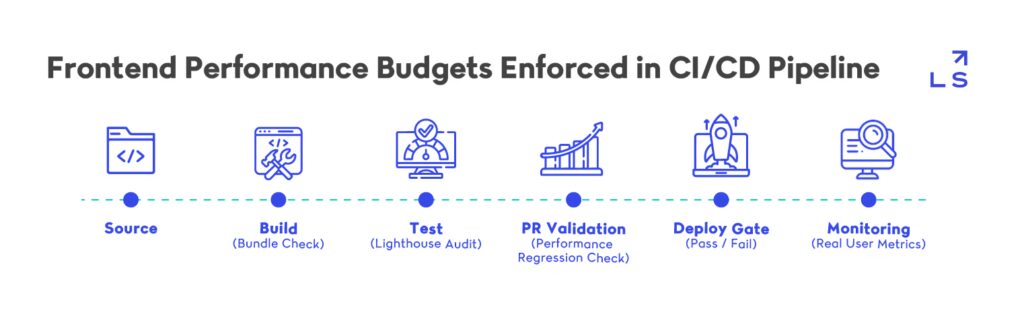
This pipeline view highlights how Frontend Performance Budgets move from guidelines to enforceable constraints embedded directly into the delivery process.
Feedback Loops and Developer Workflow Integration
Strict enforcement alone is not enough. If budgets are only visible when a pipeline fails, they create friction instead of alignment.
Effective systems integrate these directly into the developer workflow. This includes:
- real-time feedback on bundle size during development
- visibility into performance impact at the pull request level
- dashboards tracking budget consumption over time
This creates a continuous feedback loop where developers understand the impact of their changes immediately, rather than after integration.
A non-obvious effect is that these budgets reshape how developers reason about systems. Changes are evaluated not only in terms of functionality, but also in terms of execution cost and system impact.
JavaScript plays a central role in this process. Its execution directly affects main thread blocking and responsiveness, making it one of the most critical components to control within Frontend Performance Budgets, particularly as excessive main thread work quickly degrades interactivity.
Scaling Frontend Performance Budgets Across Teams
From Individual Responsibility to System Governance
Performance budgets often start as a local practice—defined by a single team or enforced within a specific project. This works in early stages, but it breaks down as organizations scale.
As more teams contribute to the same frontend ecosystem, Frontend Performance Budgets must evolve from isolated constraints into a governed system. Without this shift, inconsistencies emerge:
- different teams define different thresholds
- enforcement becomes uneven
- performance expectations drift over time
Scaling Frontend Performance Budgets requires a shared model where constraints are defined centrally but applied consistently across teams. This ensures that performance remains predictable, regardless of how many teams are contributing to the system.
This mirrors how scalable delivery systems evolve, where consistency across teams becomes more important than local optimization.
Frontend Performance Budgets in Multi-Team and Microfrontend Architectures
In multi-team environments—especially those using microfrontend architectures—Frontend Performance Budgets become significantly harder to enforce.
Each team owns a portion of the application, but users experience the system as a whole. This creates a coordination problem:
- duplicated dependencies increase total bundle size
- inconsistent loading strategies impact rendering
- independent releases introduce unpredictable performance interactions
Frontend Performance Budgets must therefore operate across boundaries, not just within them. Instead of defining limits per team, organizations need:
- shared dependency policies
- global performance thresholds
- coordination mechanisms across independently deployed components
A non-obvious challenge is that local optimization can still produce global degradation. A team may stay within its own budget while contributing to overall system slowdown due to cumulative effects.
This is structurally similar to real-time data systems, where independent pipelines can introduce latency when combined without coordination.
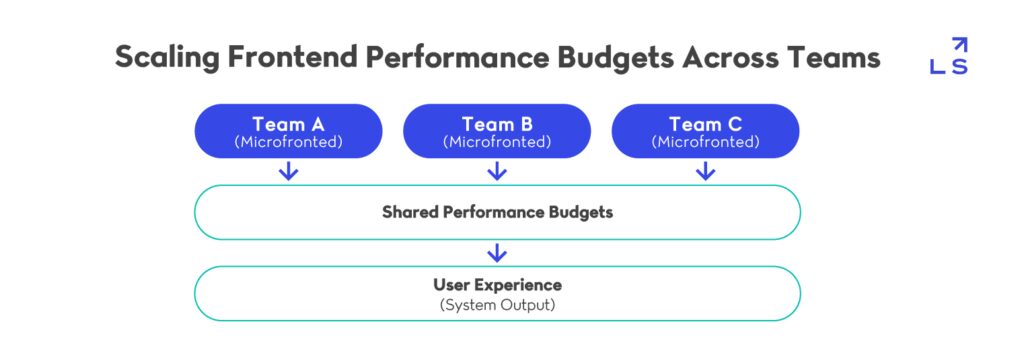
This model highlights how Frontend Performance Budgets shift from team-level guidelines to system-level constraints that govern the combined output of multiple independent contributions.
Aligning Performance Budgets with Platform and DevOps Practices
To scale effectively, performance budgets must be embedded into platform-level systems rather than managed manually by individual teams.
This typically involves:
- shared tooling for performance validation
- centralized budget definitions
- integration into internal developer platforms
At this stage, performance budgets become part of the broader delivery ecosystem. They are no longer just frontend concerns—they are integrated into DevOps workflows, platform engineering, and system governance.
A key insight is that frontend performance budgets behave similarly to other system-level constraints, such as deployment policies or infrastructure limits. They require the same level of automation, visibility, and enforcement.
This is closely aligned with how modern platform engineering approaches standardize developer workflows and system constraints across teams.
Where Frontend Performance Budgets Fail (and Why)
Treating Frontend Performance Budgets as Static Thresholds
One of the most common failure modes is treating Frontend Performance Budgets as fixed numbers that remain unchanged over time. While defining initial thresholds is necessary, systems evolve, and static budgets quickly become misaligned with reality.
As applications grow, new features, integrations, and architectural changes introduce different performance characteristics. If performance budgets are not revisited, they either become:
- too strict, blocking necessary development
- too loose, allowing gradual degradation
The failure is not in the budgets themselves, but in treating them as configuration instead of as part of a living system.
The budgets must evolve alongside the system they constrain. This requires periodic recalibration based on real user data, device distribution, and performance trends, rather than relying on initial assumptions.
This aligns with how performance is evaluated in real-world systems, where metrics must reflect changing conditions and usage patterns.
Local Optimization Without Global Awareness
Another failure mode emerges in multi-team environments: optimizing locally while degrading the system globally.
A team may fully comply with its own performance budgets—keeping bundle size within limits and passing all checks—yet still contribute to overall system slowdown. This happens when multiple independently optimized components are combined into a single user experience.
Typical causes include:
- duplicated dependencies across microfrontends
- overlapping functionality delivered by different teams
- inconsistent loading and rendering strategies
Budgets pplied at the team level are insufficient in these environments. Without a global perspective, local compliance can mask systemic inefficiency.
A non-obvious implication is that performance budgets must operate at multiple levels:
- local budgets for teams
- global budgets for the combined system
This reflects a broader pattern in distributed systems, where independently optimized components can still introduce bottlenecks when combined into a single execution path, particularly when coordination between them is limited.
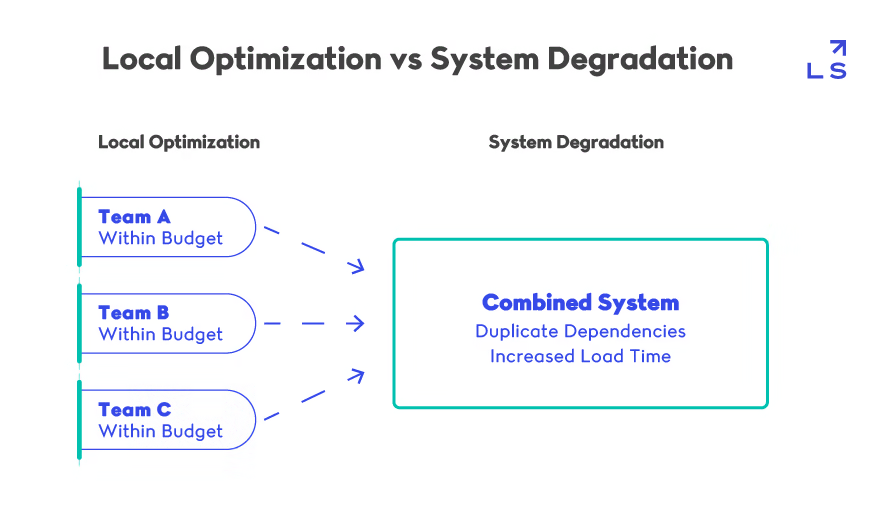
This illustrates how Frontend Performance Budgets must extend beyond individual teams to operate as system-level constraints across the entire application.
Enforcing Frontend Performance Budgets Without Developer Context
Enforcement without context is another common failure point. When performance budgets are applied as strict gates without visibility, they create friction rather than alignment.
Developers encounter failed builds or blocked pull requests without understanding:
- what caused the regression
- how much impact the change introduced
- what tradeoffs are acceptable
This leads to behaviors such as:
- bypassing checks
- optimizing blindly without clear direction
- resisting performance constraints altogether
Performance budgets are effective only when they are paired with meaningful feedback. Developers need to understand not just that a budget was exceeded, but why it matters and how to address it.
This is consistent with how effective feedback systems operate in engineering environments, where visibility and context drive better decision-making rather than strict enforcement alone.
Frontend Performance Budgets as a Foundation for Scalable Frontend Systems
Budgets ultimately shift how frontend systems are designed, not just how they are measured. When treated as system-level constraints, Frontend Performance Budgets become part of the architecture itself, influencing decisions long before code is written.
This changes the role of performance in engineering organizations. Instead of being a quality attribute evaluated after delivery, performance becomes a defining property of the system. Every architectural decision—rendering strategy, dependency management, data loading—exists within the boundaries defined by budgets.
As systems scale, this becomes critical. Without Frontend Performance Budgets, growth introduces entropy: more teams, more dependencies, more variability. With these budgets, growth is constrained in a way that preserves consistency and predictability.
A key implication is that these budgets enable teams to scale independently without compromising the system as a whole. By enforcing shared constraints, they reduce the need for constant coordination while still maintaining alignment across teams.
This aligns with how modern frontend architectures evolve toward modular and distributed systems, where coordination is minimized and constraints are embedded directly into the platform.
From Optimization to System Design
The most important shift is conceptual. Frontend Performance Budgets are often introduced as an optimization technique, but their real value lies in system design.
When properly implemented, Frontend Performance Budgets:
- define acceptable system boundaries
- expose tradeoffs early
- prevent architectural drift
- enforce consistency across teams
This reframes performance from a technical concern into a structural one. It becomes part of how systems are shaped, not just how they are improved.
A non-obvious consequence is that teams no longer need to constantly “optimize performance.” Instead, they operate within a system where performance degradation is structurally limited.
The Strategic Role of Frontend Performance Budgets in 2026
As frontend ecosystems continue to evolve—driven by microfrontends, distributed teams, and increasingly complex user experiences—the need for constraint-based systems becomes more pronounced.
Frontend Performance Budgets are not just a technical practice; they are a strategic capability. They allow organizations to:
- scale frontend development without losing control
- maintain consistent user experience across teams
- reduce long-term performance debt
In this context, performance budgets function similarly to other system-level constraints in engineering, such as API contracts or infrastructure limits. They define what is acceptable, enforce consistency, and enable systems to grow without becoming unpredictable.
Looking forward, the organizations that treat performance budgets as part of their platform—not as optional guidelines—will be the ones able to scale frontend systems efficiently while maintaining performance as a core property of the user experience.