Staff augmentation sells itself on control. Bring in outside engineers, slot them into existing teams, keep every priority call and sprint decision in-house. It’s the opposite of handing a whole project to an outsourcer and hoping the result matches the brief, and it’s why staff augmentation has become the default choice for companies that need capacity without giving up the ability to redirect that capacity on short notice.
That control is real, and it’s genuinely the model’s strongest argument. It also comes with a cost most companies don’t price in up front: the client, not the vendor, now owns every access decision those augmented engineers need to do their job. Source code, cloud environments, customer data, internal documentation.
Someone has to decide who gets what, and someone has to remember to take it away again. In a traditional outsourcing arrangement, the vendor absorbs a meaningful share of that burden, because the vendor’s own team is the one doing the work inside its own managed environment. Staff augmentation moves the work inside the client’s environment instead, and the governance responsibility moves with it.
Six findings below look at how that access gets granted, how rarely it gets reviewed, and what happens to it after the engagement ends. None of this argues against staff augmentation. It argues that the control staff augmentation is known for comes paired with a governance workload most companies haven’t actually staffed for.
Staff augmentation keeps control in-house, and the access burden with it
Before looking at the risk data, it’s worth being precise about why staff augmentation shifts so much of the access burden onto the client in the first place. The answer is the same feature that makes the model attractive.
The model’s whole appeal is the control it keeps in-house
Unlike project outsourcing, where a vendor’s own management owns delivery, staff augmentation keeps augmented engineers reporting into the client’s existing structure. Code review, sprint priorities, and architecture decisions all stay with the client’s own leads.
That’s precisely why companies choose it over outsourcing when the work is sensitive enough that they don’t want to hand it off entirely. A startup building its core product, or a regulated company working on something it can’t fully describe to an outside vendor’s project managers, gets to keep decision-making close while still filling a real skills gap. The trade-off for that closeness is everything the next section covers.
That same control also means the access review burden never leaves the client
Keeping control in-house means the client’s own IT and security teams, not the vendor’s, are responsible for provisioning, scoping, and eventually revoking every credential an augmented engineer uses. A vendor delivering a fixed outcome absorbs a lot of that operational overhead by default.
A vendor supplying people for a client-run team does not, and most companies adopt staff augmentation for its speed and flexibility without budgeting for that extra layer of access management work. The decision to use staff augmentation usually gets made by engineering leadership looking for capacity. The access management consequences of that decision usually land on security and IT teams who weren’t in the room when it was made.
Third-party involvement in breaches reached 48% in a single year
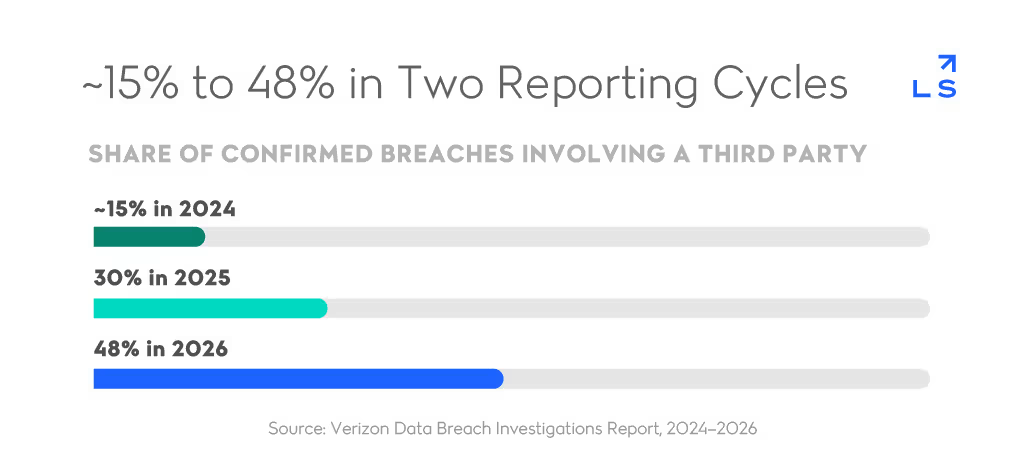
The access question isn’t theoretical. It shows up directly in breach data, and the trend line is getting worse quickly. Three consecutive editions of the same annual report have now tracked the same metric moving in the same direction, which is a harder pattern to dismiss as noise than a single bad year would be.
Verizon’s 2026 DBIR found third-party involvement more than tripled in two years
Verizon’s 2026 Data Breach Investigations Report found that third-party involvement in confirmed breaches reached 48%, up from 30% the year before and roughly 15% the year before that. In two reporting cycles, the share of breaches involving a vendor, supplier, or partner more than tripled. Verizon’s category is broad, covering vendors in the software supply chain, vendors hosting data, and vendors connected into a company’s environment. Staff augmentation engagements fall within that last group: an outside professional with legitimate, client-granted access to internal systems, not an outsider breaking in but someone the company chose to bring on board.
A single compromised support platform at EY shows what that looks like in practice
In July 2026, Ernst & Young disclosed that an unauthorized party had accessed a third-party IT support platform used by its own IT staff, downloading documents attached to support tickets between late March and mid-April. EY said those documents may include client names, addresses, Social Security numbers, bank details, and tax records. The access didn’t come through EY’s core internal systems. It came through a third-party tool trusted enough to hold sensitive files.
That’s the same shape of risk staff augmentation introduces at a smaller scale with every engineer given a login. A single support platform, scoped for one narrow purpose, still carried enough trust and reach to expose tax records for a Big Four firm’s clients. An augmented engineer’s credentials rarely carry less reach than that platform did. Most carry more, since the whole point of bringing someone in is giving them enough access to be useful immediately.
The access question isn’t theoretical. It shows up directly in breach data, and the trend line is getting worse quickly, not slowly. Two consecutive years of the same annual report have now tracked the same metric moving in the same direction, which is a harder pattern to dismiss as noise than a single bad year would be.
Most companies never actually vet who they’re granting access to
Access is only as safe as the diligence behind it, and the diligence most companies do is thinner than the stakes call for. A staff augmentation decision usually gets evaluated on rate, availability, and skill match. Security diligence on the vendor itself rarely makes that same shortlist of questions, even though it’s the one most directly tied to what happens after the engagement starts.
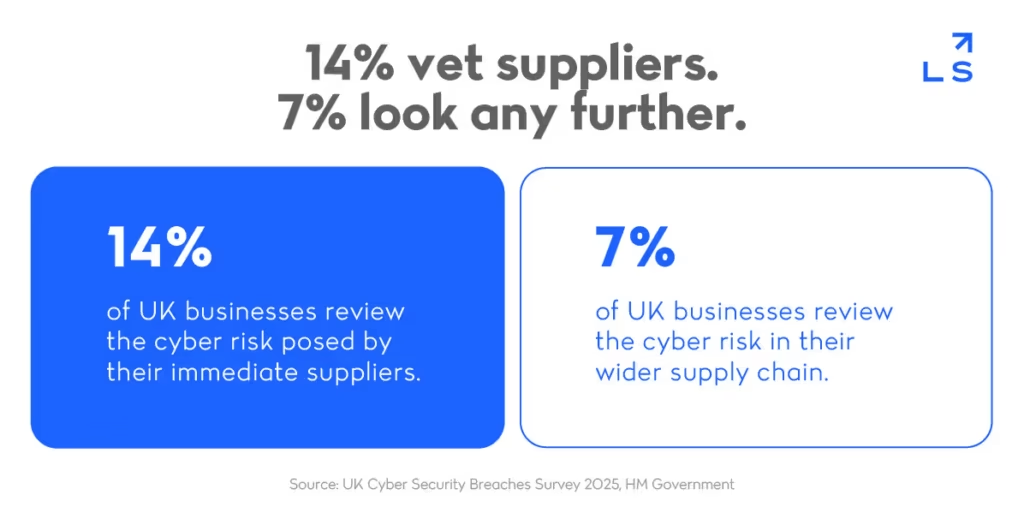
Only 15% of UK businesses review their immediate suppliers’ cyber risk
The UK government’s Cyber Security Breaches Survey 2025/2026, published in April 2026, found that just 15% of businesses formally review the cyber security risks posed by their immediate suppliers. Large businesses do noticeably better, at 48%, which still leaves more than half of large companies granting supplier access without a formal review.
Smaller businesses, the ones most likely to lean on staff augmentation instead of building a large internal team, sit far below that. Micro businesses review supplier risk at 12%, a quarter of the rate large businesses do, which means the companies most dependent on outside staff for core capacity are also the ones least likely to have checked who they’re letting in.
Just 6% look past that first layer to the wider supply chain at all
The same survey found only 6% of businesses extend that review beyond their immediate suppliers to the wider supply chain, the sub-contractors and tools those suppliers themselves depend on. A staff augmentation vendor’s own security practices, and the practices of any tooling that vendor uses to manage its own people, rarely get examined at all before a staff augmentation engagement begins.
The review most companies skip isn’t a deep one. It’s the first one. A basic questionnaire about how a staff augmentation vendor screens, equips, and offboards its own people would catch a meaningful share of the risk covered in this piece, and most companies never ask it, let alone go further and verify the answers.
Access doesn’t end when the engagement does
Granting access correctly at the start of an engagement solves half the problem. The other half shows up months later, after everyone has stopped thinking about it. Staff augmentation engagements end for ordinary, unremarkable reasons: a project wraps, a budget gets reallocated, a contract simply isn’t renewed. None of those endings come with a built-in trigger for an access review.
83% of former employees admit keeping access to at least one account
A Beyond Identity study found that 83% of former employees admitted to maintaining continued access to at least one account from a previous employer. The study dates from 2022 and covered employees broadly, not staff augmentation specifically, but the underlying mechanism applies just as directly to a contractor whose engagement quietly wound down, and arguably more so, since contractors rarely go through a formal HR exit process.
A login that worked on day one of the project usually still works long after the project ends, unless someone actively closes it. The contractor isn’t necessarily doing anything with that access. Most never log back in at all. But a credential nobody is tracking is a credential an attacker can use just as easily as the person it was issued to, and the organization has no way of knowing the difference until something goes wrong.
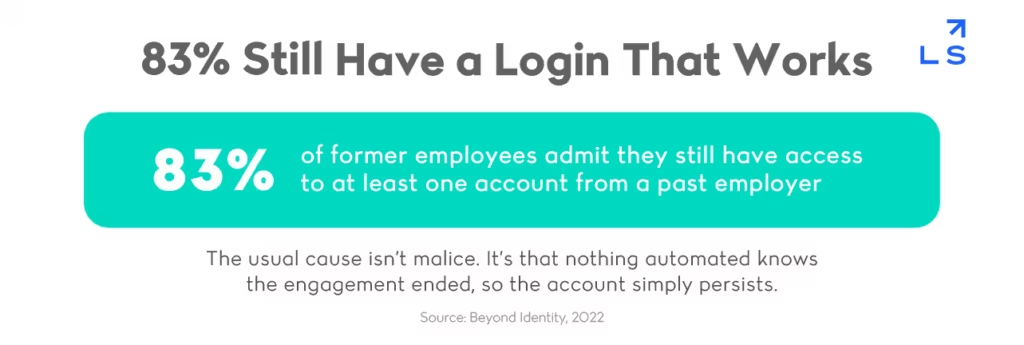
The usual cause isn’t malice. It’s that nothing automated knows the engagement ended
An augmented engineer’s access rarely gets provisioned through the same formal process as a full-time hire’s, and it rarely gets deprovisioned through one either. A staff augmentation contract ending is a commercial event between two companies. It doesn’t automatically trigger an access review inside whatever systems the engineer touched, which means the account simply persists until someone remembers to check, if anyone ever does.
Picture the ordinary version of this, not the dramatic one. An engineer joins for a six-month project, gets added to the relevant repositories and a handful of internal tools, and finishes the work on schedule. The invoice gets paid, the relationship ends on good terms, and nobody files a ticket to close the accounts, because closing accounts was never anyone’s explicit job. Multiply that single unremarkable ending by every staff augmentation engagement a company has run over several years, and the number of still-open doors adds up fast, even without a single person acting in bad faith.
The control staff augmentation promises assumes a governance maturity most companies don’t have
Put the first four findings together and a pattern emerges: staff augmentation’s defining strength, keeping management in-house, is also exactly where the risk concentrates. Every advantage staff augmentation offers over outsourcing (speed, flexibility, direct oversight) assumes the client has the internal muscle to manage what it’s now responsible for. Most companies have the advantages. Fewer have built the muscle.
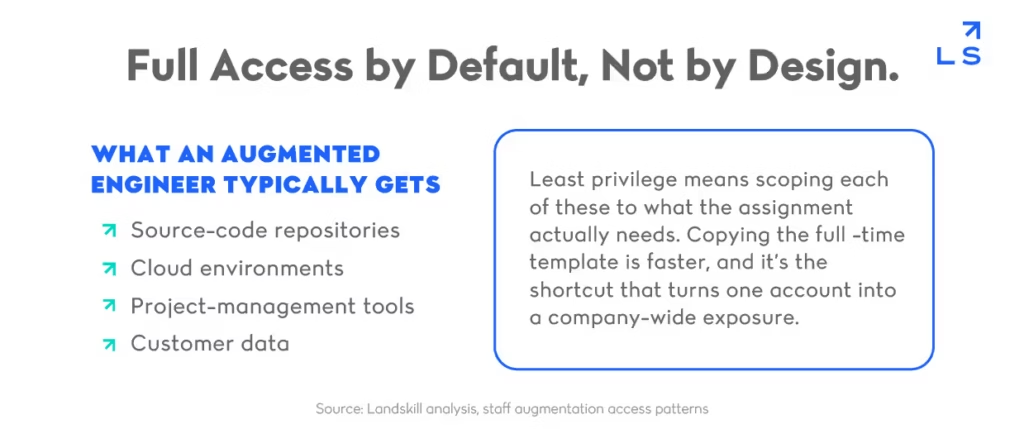
Augmented staff routinely get the same system access as full-time employees
Augmented developers typically need access to source-code repositories, cloud environments, project-management tools, and customer data to do the job they were brought in for. Scoping that access tightly, following the principle of least privilege so each person gets only what the specific assignment requires, takes deliberate process.
Granting the same broad access given to a full-time hire is faster and more common, and it’s exactly the shortcut that turns one compromised contractor account into a company-wide exposure. The engineer brought in to fix one service rarely needs read access to every other repository in the organization, but revoking that extra access after the fact almost never happens once it’s been granted by default at the start.
A vendor’s own security posture still matters, even when the vendor doesn’t manage daily work
Staff augmentation clients sometimes treat vendor security diligence as unnecessary precisely because they’re the ones managing the engineers day to day. That reasoning skips a step.
The vendor still recruits, background-checks, equips, and offboards the people it places, and a vendor with weak practices in any one of those areas hands the client risk the client never signed up to manage, regardless of who’s running the daily standup. A certification like ISO 27001 is one concrete way a client can confirm a staff augmentation vendor treats that part of the relationship seriously, rather than taking it on faith because the engineers themselves report to the client’s own managers. Landskill operates under the JOYN Group’s ISO/IEC 27001 certification, which covers every company in the group.
Growth is outpacing oversight, not the other way around around

None of the findings above are a reason to avoid staff augmentation. They’re a reason to stop treating vendor and access governance as an afterthought to a model whose central appeal is control. The last finding isn’t a new risk so much as a reminder that every risk already covered gets larger, not smaller, as the model keeps growing.
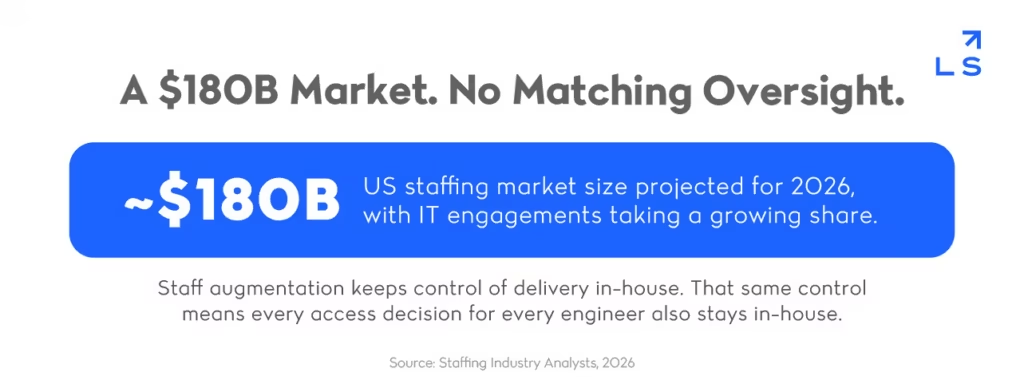
The US staffing market alone is projected to reach $183 billion in 2026
Staffing Industry Analysts projects the US staffing market will grow 2.4% in 2026 to reach $183.1 billion. A market of that scale pulls in capacity steadily, including staff augmentation vendors with varying levels of security maturity and clients under pressure to fill a role quickly rather than vet one carefully. Speed and governance don’t trade off automatically. They trade off when nobody deliberately protects the second one while chasing the first, and a large, busy market makes that trade-off easier to make by accident.
Growth without matching investment in access governance compounds the exposure
Every one of the numbers above (the 48% of breaches with a third party involved, the 15% of businesses that review supplier risk, the 83% of former staff who keep some access) matters more as the number of staff augmentation engagements keeps rising. The same pattern shows up in AI vendor risk, where a vendor approved during one review cycle can look nothing like the vendor still running in production by the next one. A staff augmentation contractor isn’t a static risk either. Access needs the same kind of ongoing attention a one-time background check was never designed to provide.
What this means for teams evaluating staff augmentation
Staff augmentation’s control advantage over outsourcing is real, and the six findings above don’t undo it. What they add is the other half of the model: the client that keeps control also keeps every access decision that comes with it, and most companies are better at making that decision on day one than they are at revisiting it on day two hundred.
None of the fixes implied by the findings above require abandoning staff augmentation or adding significant cost to it. Vetting a vendor’s security practices before the first engineer starts is a conversation, not a project. Scoping access to the role instead of copying a full-time template is a policy decision, not new infrastructure. The hardest of the three, building a process that automatically revisits access when an engagement ends, is also the one most likely to get skipped precisely because nothing forces the question without a deliberate trigger in place.
A useful starting point isn’t a wholesale policy change. It’s three specific questions worth asking about any current staff augmentation engagement: whether the vendor’s own security practices were actually reviewed before the first engineer started, whether access is scoped to what the role needs rather than copied from a full-time template, and whether there’s a process that automatically revisits that access when the engagement ends rather than relying on someone remembering.
Those three questions cost nothing to ask and very little to answer honestly. What they buy a company running staff augmentation at any scale is the difference between a model that delivers the control it promises and one that quietly accumulates the exact risk that control was supposed to prevent. Talk to Landskill about where your own staff augmentation program sits against those three questions.